How many candidates use AI assistants in technical interviews: what the 2025–2026 data says
TL;DR: between a fifth and a third of candidates say they have used AI during a job interview, and detection platforms flag 35–48% of sessions. The two numbers measure different things. Flags grew roughly twofold in a year, the share of interviews where AI is officially part of the task is still small but growing, and companies disagree on whether AI in an interview is cheating or simply how the work is done now. The country picture is patchy: only the US and Brazil have country-level surveys of AI use during interviews, so the map below is an estimate, and it is labelled as one.
I build consigliere, an interview assistant for Linux, so I have a stake in this topic. That makes me want to be careful with the numbers. Every figure below comes with its source, and I left out the ones I could not trace back to a primary source.
Two kinds of numbers
Surveys ask people whether they used AI in an interview. They undercount, because admitting it costs something even in an anonymous survey. Detection platforms count the sessions their models found suspicious. They overcount: a flag is a suspicion, and the vendors who sell detection have no reason to report low numbers.
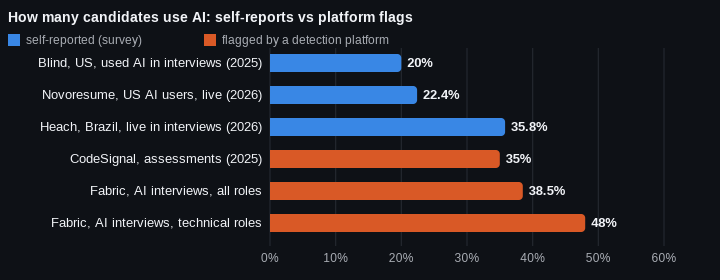
| Source | Sample | What it found |
|---|---|---|
| Blind (April 2025) | 3,617 verified professionals; 2,510 answered this question | 20% of US professionals have secretly used AI tools during job interviews; 55% call it the new norm. |
| Novoresume, Pollfish survey (February 2026) | 858 US workers who use AI | 22.4% used AI in real time during a live video interview. |
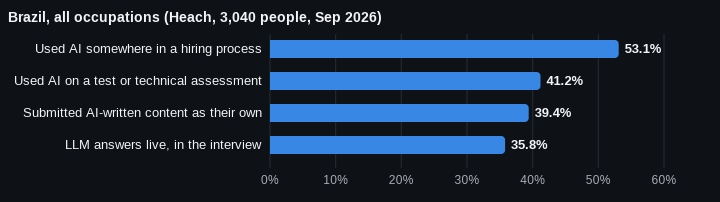
| Heach Recursos Humanos, via Valor (September 2026) | 3,040 people in Brazil hired or interviewed in the last 24 months, all occupations | 53.1% used AI somewhere in a hiring process; 35.8% used an LLM to answer in real time during interviews. |
| CodeSignal (February 2026) | Its assessments in 2025 | Cheating or fraud attempts in 35% of assessments, up from 16% in 2024. |
| Fabric (January 2026) | 19,368 AI-run interviews, July 2025 – January 2026 | 38.5% of candidates flagged; 48% in technical roles against 12% in sales. |
| Karat (January 2026) | 400 engineering leaders, US, India, China | Leaders estimate that over half of candidates use AI despite being told not to. |
My reading: something like 20–35% of candidates use AI live, and the 35–48% from detection platforms is an upper bound on the same thing.
A flag is not a verdict
Two things to keep in mind when someone quotes the 48%.
First, automated detection is biased against people who speak or write carefully in a second language. A Stanford study (Liang et al., 2023) ran seven commercial GPT detectors on TOEFL essays written by non-native speakers and on essays by US eighth-graders: on average, 61% of the TOEFL essays were labelled AI-generated, against near-zero false positives for the native speakers. Plain, grammatical, textbook English has low perplexity, and so does model output. The study looked at written text, not interviews. Interview detectors that score speech and answers rely on similar signals, and none of them has published an independent audit.
Second, the flags do not predict much. In Fabric's own data, 61.1% of flagged candidates scored at least 7.0, the threshold to advance. You can read that as "cheating works". I read it differently: if a prepared script can pass the interview, it does not matter much who wrote the script, the interview was not measuring much. Interviews where the next question depends on what the candidate just said do not have this problem.
Growth
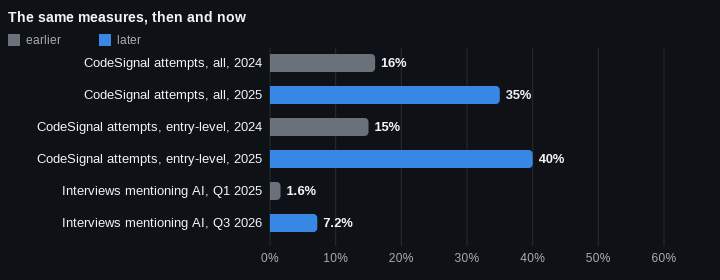
CodeSignal's attempt rate more than doubled in a year, and the jump was largest at entry level, from 15% to 40%. Juniors are where interviews lean hardest on standard problems with standard answers.
The interviews themselves are changing too. Interview Query looked at 59,738 interview reports from 639 companies: the share that mention AI (LLMs, generative AI and the like) grew from 1.6% in Q1 2025 to 7.2% in Q3 2026. Rounds where AI is officially part of the coding task are still rare: 37 of 3,368 in its sample, about 1.1%. Mentions of AI interviewers, bots that run the interview themselves, are up 14 times since 2024.
By region
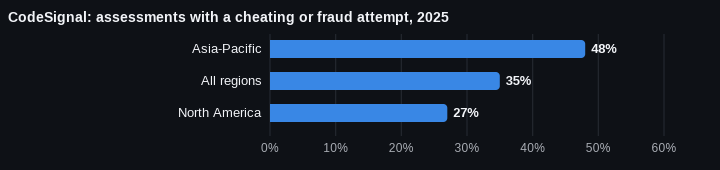
The one source that compares regions with a single method is CodeSignal: the attempt rate in Asia-Pacific was almost double the North American one.
Brazil has the most direct survey of AI use during interviews. It covers every kind of job, and the numbers are high even so:
The US has two surveys that roughly agree, 20% (Blind) and 22.4% of AI users (Novoresume). interviewing.io adds the interviewers' side: of 63 interviewers who answered, 81% of those at Big Tech and New Big Tech companies had suspected a candidate of using AI, and 31% had caught one.
For India I could not find a country-level survey, which surprised me, since it is the country most often named as the leader. The indirect signs all point up: Asia-Pacific has the highest flag rates, and OpenAI reported that Indian ChatGPT users use its data-analysis tool at nearly four times the global average and Codex at about three times.
China is different. In Karat's survey, 68% of Chinese companies allow AI in live interviews against 38% in the US. Using AI there is more often part of the interview than a way around it.
In the UK, in the Institute of Student Employers' 2026 survey, undeclared AI use in interviews was the most common form of candidate misconduct, reported by 66% of the employers surveyed.
Russia has numbers on preparation only: in a survey of 10,000 people by Avito Rabota and MTS Link, 40% had used AI to prepare for an interview, 65% among 18–24-year-olds. On the employer side, a platform that ran 59,332 AI interviews in the first half of 2026 reported that 82% of candidates rated the format positively.
A heat map
The map is my estimate, not a dataset. Only Brazil and the US rest on a survey of AI use during interviews. I extrapolated every other country from proxies (employer surveys, preparation surveys, general AI adoption, platform volume) and regional trends, and those countries are hatched.
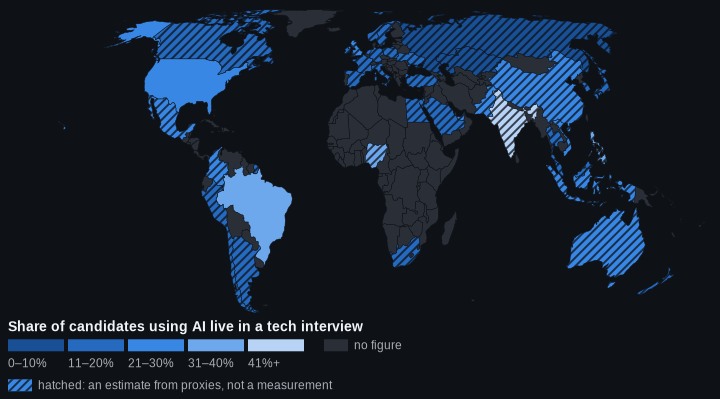
All 41 estimates and what each is based on
| Country | Estimate | Type | Basis |
|---|---|---|---|
| India | 45% | estimate | No country survey. Platform flag rates are highest in Asia-Pacific (CodeSignal 48%), ChatGPT use for technical work is well above the global average. |
| Brazil | 36% | survey | Heach: 35.8% used an LLM for answers live in interviews (all occupations). |
| Nigeria | 35% | estimate | Regional trend; no country survey. |
| Philippines | 32% | estimate | Regional trend; no country survey. |
| China | 30% | estimate | Karat: 68% of companies allow AI in live interviews, so use is often not hidden. |
| United Kingdom | 28% | estimate | ISE: 66% of employers surveyed saw undeclared AI use in interviews. |
| Indonesia | 28% | estimate | Regional trend; no country survey. |
| Australia | 25% | estimate | Morgan McKinley: 57% of workers used AI tools in a job search. |
| Pakistan | 25% | estimate | Regional trend. |
| Colombia | 24% | estimate | Fast-growing ChatGPT use in Latin America. |
| United States | 23% | survey | Blind: 20% used AI in interviews; Novoresume: 22.4% of AI users did so live. |
| Mexico | 22% | estimate | Fast-growing ChatGPT use in Latin America. |
| Singapore | 22% | estimate | High AI adoption. Too small for the map. |
| Vietnam | 22% | estimate | Regional trend, IT outsourcing. |
| United Arab Emirates | 22% | estimate | High AI adoption. |
| Canada | 20% | estimate | Assumed close to the US. |
| South Korea | 20% | estimate | High AI adoption. |
| New Zealand | 20% | estimate | Assumed close to Australia. |
| Argentina | 20% | estimate | Latin American trend. |
| Malaysia | 20% | estimate | Regional trend. |
| Israel | 20% | estimate | Large tech sector. |
| Ireland | 19% | estimate | Assumed close to the UK. |
| Peru | 19% | estimate | Fast-growing ChatGPT use in Latin America. |
| Germany | 18% | estimate | European trend. |
| Netherlands | 18% | estimate | European trend. |
| Turkey | 18% | estimate | Regional trend. |
| Chile | 18% | estimate | Latin American trend. |
| South Africa | 18% | estimate | Very little data. |
| Saudi Arabia | 18% | estimate | Regional trend. |
| France | 17% | estimate | European trend. |
| Thailand | 17% | estimate | Regional trend. |
| Poland | 16% | estimate | European trend. |
| Spain | 15% | estimate | European trend. |
| Sweden | 15% | estimate | European trend. |
| Egypt | 15% | estimate | Very little data. |
| Ukraine | 15% | estimate | Very little data. |
| Italy | 14% | estimate | European trend. |
| Norway | 14% | estimate | European trend. |
| Japan | 12% | estimate | More conservative hiring market. |
| Kazakhstan | 10% | estimate | Very little data. |
| Russia | 8% | estimate | Avito Rabota and MTS Link: 40% used AI to prepare for an interview; no figure for live use. |
The employer side
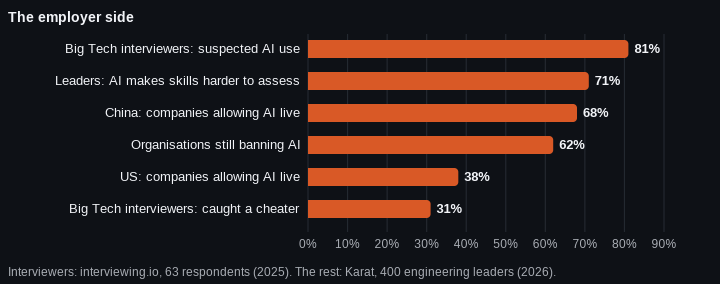
In Karat's survey, 62% of organisations still prohibit AI in technical interviews, 71% of leaders say AI makes technical skills harder to assess, and the same leaders estimate that over half of candidates use AI anyway. I don't expect a ban that most candidates ignore, and that interviewers can only suspect, to last long.
Some companies already allow AI in the interview and assess how the candidate uses it. Meta has started replacing one onsite coding round with an AI-enabled one, with an assistant built into the editor (it began as a pilot). Canva went further: since June 2025 its AI-assisted coding round expects candidates to use tools like Cursor, Copilot or Claude, and says so publicly, while treating blind acceptance of the output as a red flag. In these rounds the candidate is judged on framing the problem, checking the output, explaining the decisions and answering follow-up questions.
What this means
There is no single answer to "how many candidates use AI". Surveys say 20–36%, detection says up to 48%, and the real number is somewhere between them. The country data is thin: Brazil and the US are measured, while India, the most quoted leader, is inferred.
Hiring is slowly moving from "ban and detect" to "allow and assess". In an interview like that, an assistant is one more tool on the desk, and the interview tests how well you use it.
consigliere is built for that. It is a visible window on your own screen: it transcribes the conversation, reads the task and drafts an answer that you still have to understand and explain. Nothing about it is hidden. Use it where AI is allowed, in mock interviews and for practice. Where an interview forbids AI, follow its rules.
Sources
- Fabric, State of AI interview cheating in 2026: insights from 19,368 interviews, January 2026.
- CodeSignal, press release on 2025 cheating and fraud attempts, February 2026.
- Karat, Engineering interview trends in 2026, January 2026.
- Interview Query, AI in technical interviews, 2026 data, October 2026.
- Valor Econômico, 53% dos candidatos já usaram IA em processos seletivos (Heach Recursos Humanos survey), 20 October 2026.
- CNews, Avito Rabota and MTS Link survey, 17 September 2026; 82% of candidates rate AI interviews positively, 24 September 2026.
- Blind, survey of 3,617 verified professionals, April 2025.
- interviewing.io survey of interviewers, as reported by The Pragmatic Engineer (The Pulse #146), September 2025.
- Novoresume, AI in the workplace survey (Pollfish, February 2026).
- OpenAI, how India uses ChatGPT (Signals), February 2026.
- Institute of Student Employers, 2026 survey on candidate misconduct; Morgan McKinley, AI in job search, Australia, July 2026.
- Liang et al., GPT detectors are biased against non-native English writers, 2023.